
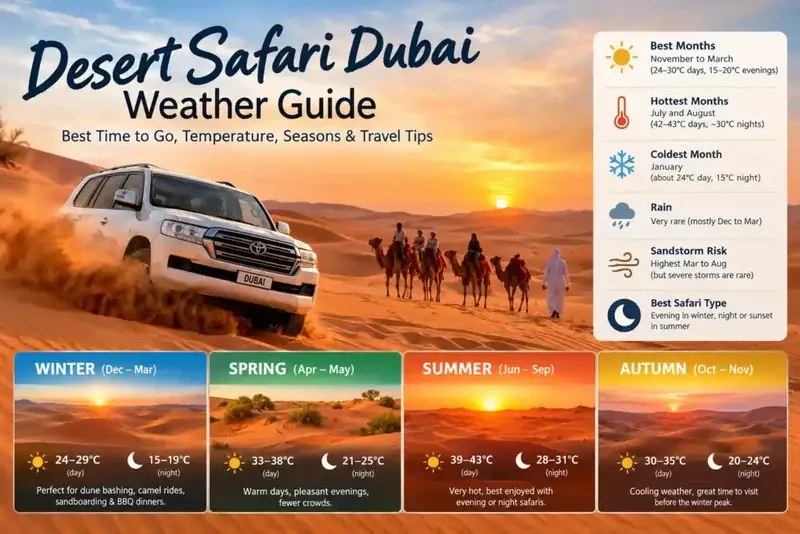
The best desert safari Dubai weather is from November to March, when daytime highs are about 24–30°C (75–86°F) and evenings cool to 15–20°C (59–68°F). Safaris run all year. In summer (June to September), highs reach 39–43°C (102–109°F), so book an evening or night safari that departs after 4 PM.
Most weather guides give you a city forecast, but the desert behaves differently. This guide gives you the average temperature for every month, how cold the dunes get at night, what summer really feels like, how sandstorms are handled and which safari type matches each season. If you are still choosing a trip, see our jeep safari Dubai guide for tours and prices.
Winter is ideal for dune bashing, camel riding, sandboarding and BBQ dinners under the stars. Even in July, smart planning lets you enjoy the dunes.
Desert Safari Dubai Weather at a Glance
| Question | Short answer |
|---|---|
| Best months | November to March (24–30°C days, 15–20°C evenings) |
| Hottest months | July and August (42–43°C days, about 30°C nights) |
| Coldest month | January (about 24°C day, 15°C night) |
| Are safaris open in summer? | Yes, mostly evening and night departures after 4 PM |
| Do nights get cold? | Yes, 10–16°C in December to February, and a jacket is essential |
| Rain | Very rare, mostly December to March |
| Sandstorm risk | Highest between March and August, but severe storms are rare |
| Best safari for the weather | Evening in winter, night or sunset in summer |
Why Does the Desert Feel Different from Dubai City?
The desert loses heat much faster than the city, so afternoons and evenings in the dunes often feel cooler than the coast. Dubai has an arid desert climate with two main seasons, winter and summer, separated by two short transition periods.
📌 Key fact: The UAE National Centre of Meteorology reports winter (December to March) mean temperatures of 16.4–24°C and summer averages of 32–37.2°C. Source: UAE Climate Fact Sheet, National Centre of Meteorology.
Sand absorbs strong sunlight by day and releases the heat quickly once the sun sets. Low humidity means little moisture to hold warmth in the air. Cities, in contrast, trap heat in concrete and glass, a pattern called the urban heat island effect. By late afternoon the desert can be 7–10°C cooler than coastal Dubai, and the swing between midday and early morning can reach 15–20°C.
What Is the Desert Safari Dubai Temperature by Season?
Winter is cool and dry, summer is extremely hot, and the two transition seasons sit between them.
| Season | Months | Daytime high | Night low | Conditions |
|---|---|---|---|---|
| Winter | December to March | 24–29°C (75–84°F) | 15–19°C (59–66°F) | Cool, dry, clear skies |
| Spring (transition) | April to May | 33–38°C (91–100°F) | 21–25°C (70–77°F) | Warm, rising humidity, breezy |
| Summer | June to September | 39–43°C (102–109°F) | 28–31°C (82–88°F) | Extreme heat, higher humidity |
| Autumn (transition) | October to November | 30–35°C (86–95°F) | 20–24°C (68–75°F) | Cooling, pleasant evenings |
November sits between autumn and winter. It is the start of the best safari season, so we count November to March as peak season in this guide.
Winter (December to March): peak safari season
Winter is the best time for a desert safari in Dubai. Days are warm, skies are clear and evenings are crisp, which suits dune bashing, quad biking, camel trekking and hot air balloon rides at sunrise. The red dunes of Al Lahbab are at their best, with excellent visibility and golden light.
Nights drop to 10–18°C, and the coldest December and January nights can fall below 10°C, so an overnight safari needs a warm jacket. This is also Dubai’s busiest season, so book your desert safari well in advance, especially around Christmas and the Dubai Shopping Festival.
Best safari types: evening, overnight and sunrise desert safari.
Spring (April to May): the warm transition
Spring is still workable for a desert safari if you choose early mornings or evenings. April highs reach 32–33°C and May reaches 37–38°C. Evenings stay comfortable at 21–25°C, which makes an evening desert safari a good choice. Before 8 AM, the desert is still pleasant for dune buggy rides and sandboarding.
Spring brings fewer crowds and lower prices than winter. It is also when the Shamal winds start, which can carry dust and reduce visibility.
Best safari types: evening and early morning.
Summer (June to September): extreme heat, smart alternatives
Summer is very hot, but desert safaris still run. Daytime temperatures regularly pass 40°C and can reach 43–45°C in July and August. Most operators move departures to 4 PM or later, and night safaris with stargazing become the most popular option.
The inland desert is drier than the coast, so summer evenings in the dunes can feel more bearable than in the city. See the full summer guidance below.
Best safari types: night, sunset desert safari and late evening.
Autumn (October to November): the safari season opener
October is when comfortable desert conditions return. Daytime highs fall to 30–35°C and evenings cool to 20–24°C.
📌 Key fact: The UAE’s second transitional period (October to November) has a mean temperature of 24–30°C, marking the shift from extreme summer to pleasant winter. Source: UAE Climate Fact Sheet.
October and November are among the smartest months to visit, with better weather than summer, smaller crowds than December and competitive prices.
Best safari types: morning and evening.
What Is the Desert Safari Dubai Weather Month by Month?
January is the coldest month and August is the hottest. Use this table to plan around your exact dates.
| Month | Avg. day high | Avg. night low | Rain | Crowds | Recommended safari |
|---|---|---|---|---|---|
| January | 24°C / 75°F | 15°C / 59°F | Light, rare showers | High | Evening, overnight |
| February | 26°C / 79°F | 16°C / 61°F | Light, rare showers | High | Evening, overnight |
| March | 29°C / 84°F | 19°C / 66°F | Light | Moderate | Morning, evening |
| April | 33°C / 91°F | 21°C / 70°F | Very rare | Moderate | Early morning, evening |
| May | 38°C / 100°F | 25°C / 77°F | None | Low | Evening only |
| June | 40°C / 104°F | 28°C / 82°F | None | Low | Evening, night |
| July | 42°C / 108°F | 30°C / 86°F | None | Very low | Night, sunset |
| August | 43°C / 109°F | 31°C / 88°F | None | Very low | Night, sunset |
| September | 39°C / 102°F | 28°C / 82°F | None | Low | Evening, night |
| October | 35°C / 95°F | 24°C / 75°F | Very rare | Moderate | Morning, evening |
| November | 30°C / 86°F | 20°C / 68°F | Rare | High | All types |
| December | 26°C / 79°F | 16°C / 61°F | Occasional | Very high | All types |
📌 Key fact: Based on 1991–2020 averages, January is Dubai’s coldest month at about 19.8°C (min 15.3°C, max 24.4°C) and August is the hottest at about 36°C on average. Source: Climates to Travel, Dubai climate averages.
Desert humidity is typically 40–55% in winter and 50–65% in summer, while coastal Dubai runs 15–25% higher. These are monthly averages, so check the forecast close to your date.
Desert safari Dubai in January and February
These are the coldest months. Days suit every activity, including sandboarding, quad biking and falconry shows. Nights can dip to 10–15°C, so layer up for evening and overnight safaris and book early.
Desert safari Dubai in March
March is a sweet spot with slightly fewer tourists than January and February and still excellent weather. The first Shamal wind events of the year can bring dust.
Desert safari Dubai in April
Daytime reaches 32–33°C, so start morning desert safaris before 8 AM and prefer evening departures. Crowds thin out, which suits travellers who want a relaxed experience.
Desert safari Dubai in May
May averages 37–38°C by day, and a daytime excursion is comfortable only in the early morning. Evening safaris leaving after 4 PM are the best choice, and prices begin to drop, so look at budget desert safari Dubai deals.
Desert safari Dubai in June
Summer is in full swing at about 40°C. The inland desert is drier than the coast, which makes the heat a little more tolerable. Choose an evening or night safari with stargazing, cultural performances and campfire dining.
Desert safari Dubai in July and August
These are the hottest months, with day highs of 42–43°C and nights above 30°C. They suit night safaris and astronomy experiences. The upside is the lowest prices of the year, minimal crowds and a more personal experience in smaller groups.
Desert safari Dubai in September
September is still very hot at about 39°C, but the worst of summer is fading. Evening safaris remain the only sensible choice, and the shift toward cooler weather is noticeable by late September.
Desert safari Dubai in October
The heat breaks. Highs of 35°C and lows of 24°C suit both morning and evening safaris. Experienced visitors like October for good weather without winter crowds and prices.
Desert safari Dubai in November
November is the sweet spot at 30°C by day and 20°C at night, so every safari type works. Visitor numbers begin to rise.
📌 Key fact: In November, Dubai days are around 25–30°C with average lows of 19–21°C, and visitor numbers start to rise as the weather improves. Source: Kuoni, best time to visit Dubai.
Desert safari Dubai in December
December offers peak-season weather at 26°C by day and 16°C at night. Enjoy adventure activities by day, then traditional camp entertainment, henna painting, belly dance performances and fire shows at night. Expect the biggest crowds of the year, especially at Christmas and New Year, so book ahead.
How Cold Is the Desert at Night in Dubai?
From December to February, desert nights are 10–16°C and feel colder with the wind, so you need a jacket. The sand releases daytime heat quickly, low humidity offers no thermal blanket and open terrain lets the wind blow freely.
| Season | Night temperature | What it feels like |
|---|---|---|
| Winter (December to February) | 10–16°C (50–61°F) | Genuinely cold, jacket essential |
| Shoulder (March, October, November) | 19–24°C (66–75°F) | Cool and refreshing, light layer helpful |
| Summer (June to September) | 28–31°C (82–88°F) | Warm, but cooler than the daytime |
Wind chill: A reading of 15°C can feel closer to 8–10°C at an open-air camp, especially while you watch Tanoura dance or enjoy a camel ride with BBQ dinner under the stars.
💡 Tip: Pack a warm jacket or windproof shawl for any evening or overnight safari from November to March. A light fleece or windbreaker packs small and makes a big difference.
Early morning fog: Between December and February, fog can form before dawn and reduce visibility. It usually clears by mid-morning but can delay early morning desert safaris and balloon rides. Your operator will confirm any change.
Morning or Evening Desert Safari: Which Is Better for the Weather?
In winter both work, and in summer an evening safari is clearly better. Morning temperatures climb fast in summer and can feel oppressive by 10 AM, while evening departures let you reach the dunes as the desert cools.
| Factor | Morning safari | Evening safari |
|---|---|---|
| Winter start temperature | 15–20°C at departure, warming to 25°C+ | 25–28°C at departure, dropping to 12–18°C |
| Summer start temperature | 28–33°C at departure, climbing rapidly | 35–38°C at departure, dropping to 28–30°C |
| Best light | Sunrise golden hour | Sunset golden hour |
| Duration | 3–4 hours | 5–7 hours with dinner and shows |
| Crowds | Lower | Higher |
| Main activities | Dune bashing, quad biking, sandboarding, dune buggy, camel ride | Dune bashing, camel ride, falconry, henna, BBQ dinner, belly dance, Tanoura, fire show, stargazing |
In winter, morning desert safari Dubai trips give a calm, cool start and beautiful sunrise photos, and our evening desert safari packages give you sunset, a Bedouin camp and dinner. Check the current desert safari Dubai timings for departure times.
💡 Tip: For the best mix of weather and experience, choose an evening safari from November to February. You get comfortable temperatures, sunset photos, campfire warmth and a BBQ dinner with live entertainment in one trip.
Can You Do a Desert Safari in Dubai in Summer?
Yes. Desert safaris operate all 12 months, including June to September, but you should choose an evening or night departure. Full-day and midday excursions are not advisable.
The heat is real. Midday desert temperatures in July and August regularly reach 42–43°C, and the sand surface can be far hotter than the air. The heat index can pass 50°C on the most intense days, which is dangerous for long outdoor exposure.
What licensed operators do differently in summer:
- Departures shift to 4 PM or later.
- Night safaris with stargazing become the main offering.
- Air-conditioned Toyota Land Cruisers and Nissan Patrols are used.
- Operators carry extra water and stop more often for hydration.
- Tour length is adjusted using live data from the National Centre of Meteorology.
How to stay safe in summer heat:
- Drink at least 2–3 litres of water during the safari.
- Wear light, breathable, light-coloured clothing in cotton or linen.
- Apply SPF 50+ sunscreen and reapply every two hours.
- Wear a hat and UV-protective sunglasses.
- Avoid alcohol before and during the safari.
- Carry electrolytes or rehydration sachets.
The summer price advantage: Summer is Dubai’s off-season, so prices are lower, crowds are smaller and guides give more attention. It is a good time to book a private desert safari Dubai or luxury desert safari. See current desert safari Dubai price 2026 listings for rates.
Do Sandstorms Affect Desert Safaris in Dubai?
Sometimes, but severe sandstorms are rare and operators reschedule when conditions are unsafe. Shamal winds, strong northwesterly winds across the Arabian Peninsula, blow mainly between March and August and can lift dust and sand.
- Sandstorm: Severely reduced visibility, a handful of times per year. Safaris are cancelled or rescheduled.
- Dust haze: More common in summer. It softens sunset views but usually does not stop a tour.
Licensed operators check National Centre of Meteorology alerts and wind data before each departure, cancel or move tours when wind is unsafe for dune bashing and sandboarding, and offer rescheduling or refunds for weather cancellations.
💡 Tip: If you travel between March and August, check the forecast on the morning of your safari. If a dust or wind advisory is active, ask your operator whether the tour will go ahead.
How Do Humidity, UV Index and Heat Index Change the Weather?
Raw temperature is only part of the story. Humidity, UV and the heat index decide how the weather actually feels.
- Humidity: Coastal Dubai can reach 80–90% in summer. The inland desert where safaris run is usually 50–65% in summer and 40–55% in winter, so evenings in the dunes often feel more bearable than your hotel area.
- UV index: It ranges from moderate (5–6) in winter to extreme (11+) in summer. You can burn in 20–30 minutes without protection. By 4 PM the intensity has dropped, which is another reason to choose evening safaris in the hot months.
- Heat index (RealFeel): A 42°C air temperature with moderate humidity can feel above 50°C. In winter, the RealFeel can read cooler than the air temperature because of the dry air and desert breeze.
💡 Tip: When you check a forecast, read the “Feels Like” or “RealFeel” temperature rather than only the raw number.
What Should You Wear on a Desert Safari in Each Season?
Wear light, breathable clothes by day and add a windproof layer for winter nights. For full details, read our desert safari outfit guide.
| Season | Daytime | Evening and night | Footwear and extras |
|---|---|---|---|
| Winter (November–March) | Light cotton or linen | Warm jacket, fleece or windproof layer, plus a scarf or shawl | Closed shoes or light hiking boots for evening |
| Spring and autumn (April, May, October) | Loose, light-coloured clothes | Light jacket or long sleeves | Trainers or ankle-strap sandals |
| Summer (June–September) | Lightest, most breathable clothing, moisture-wicking fabrics | Light clothing is usually enough | Wide-brim hat, UV sunglasses, SPF 50+, breathable closed shoes, avoid metal buckles |
| Overnight (any season) | Light layers | Warm base layer, because pre-dawn is always colder than expected | Use provided blankets or bring a compact sleeping bag |
Warm drinks such as Arabic coffee (gahwa) and tea are usually served at camps and help you stay warm.
How Can You Check Desert Weather Before Your Safari?
Check the National Centre of Meteorology forecast on the morning of your safari and ask your operator about conditions. The NCM is the UAE’s official authority, and its forecasts include wind warnings, sandstorm advisories, visibility and regional temperatures, the same data safari operators use for go or no-go decisions.
- National Centre of Meteorology (NCM): Official wind, dust and temperature alerts.
- AccuWeather: RealFeel temperatures, humidity, UV index and hourly detail.
- Weather Underground: Hourly wind speed, gusts and visibility.
Check again on the day, because desert weather can change within days.
Which Safari Type Matches Your Travel Month?
Match the safari to the season: evening or overnight in winter, morning or evening in spring and autumn, and night or sunset in summer.
| If you visit in | Best safari type | Why |
|---|---|---|
| November–February | Evening or overnight desert safari | Perfect weather for dune bashing, sunset, BBQ, campfire, Tanoura and stargazing |
| March–April | Morning or evening | Cool mornings for quad biking and sandboarding, warm pleasant evenings |
| May | Evening, leaving after 4 PM | Daytime heat is building, and evenings suit top desert safari activities |
| June–September | Night or sunset | Avoid daytime heat. The desert cools quickly after sundown |
| October | Morning or evening | Season opener with comfortable conditions |
| Ramadan | Evening (check operator schedules) | Timings adjust around Iftar and evening safaris align with post-Iftar dining |
| Full moon nights | Overnight or night | Excellent for photography, stargazing and camel trekking |
Travelling with family? Winter is the safest season for children, who are more sensitive to heat and cold. See our guide to a Dubai desert safari with kids and our family-friendly desert safari Dubai packages.
Travelling as a couple? From November to February, cool evenings, clear skies and golden sunsets suit a private desert safari for couples or a romantic desert safari Dubai.
Does It Rain During a Desert Safari in Dubai?
Rain in the Dubai desert is very rare, and light rain usually does not stop a safari. The UAE averages only about 80–130 mm of rain per year, mostly between December and March, and February and March are typically the wettest months. May to September are almost dry.
📌 Key fact: Dubai’s rainfall is sparse and concentrated in winter. February and March are the wettest months, and May to September receive virtually none. Source: Kuoni, best time to visit Dubai.
A light shower can make the sand firmer, the air fresher and the dunes darker in colour. Heavy rain or a severe weather warning leads operators to reschedule for safety.
Frequently Asked Questions About Desert Safari Dubai Weather
What is the best month for a desert safari in Dubai?
November to January are best, with days of 24–30°C, clear skies and evenings of 15–20°C. December is the most popular and most crowded, while November and January balance good weather and manageable crowds.
Is desert safari Dubai open in summer?
Yes. Safaris run all year. In June to September, operators schedule evening and night departures after 4 PM, and night safaris with stargazing are the most popular option.
How cold is the desert in Dubai at night?
From December to February, nights are 10–16°C (50–61°F) and can feel colder with wind chill. Bring a warm jacket, fleece or windproof layer for any evening or overnight safari.
Can you do a desert safari in Dubai in July?
Yes, but choose an evening or night safari. July days reach 42–45°C, which makes midday activity uncomfortable and unsafe. Prices are also lowest.
Can you do a desert safari in Dubai in August?
Yes. August is similar to July with highs near 43°C. Book an evening or night safari, stay hydrated and use sun protection. The desert cools noticeably after sunset.
Is desert safari open in June in Dubai?
Yes. June safaris run on adjusted schedules, mainly evening and night departures, with hydration and sun protection essential.
Is desert safari open in May in Dubai?
Yes. May days average 37–38°C, so start morning desert safari trips very early (before 8 AM) or choose an evening departure.
What is the desert safari Dubai weather like in April?
April highs are about 33°C (91°F) with pleasant evenings of 21°C (70°F). Mornings and evenings remain comfortable, and crowds are thinner than in winter.
What is the desert safari Dubai temperature in December?
December days average 26°C (79°F) and nights 16°C (61°F), which suits every safari type. It is peak season, so book well in advance.
Is a morning or evening desert safari better for weather?
It depends on the season. In winter both are excellent, with mornings at 15–20°C and evenings settling from 25°C to 15°C. In summer an evening safari is better because morning temperatures pass 35°C by mid-morning.
Do sandstorms affect desert safaris in Dubai?
Sandstorms can occur between March and August because of Shamal winds, but severe ones are rare. Mild dust haze is more common and usually does not stop tours. Operators monitor NCM data and reschedule if visibility becomes unsafe.
Does it rain during a desert safari in Dubai?
Rarely. It happens on only a handful of days per year, mostly December to March. Light rain does not cancel safaris, and heavy rain can lead to rescheduling.
Is the desert hotter than Dubai city?
Often cooler, especially from late afternoon. The city holds heat in concrete and glass, while the desert releases it quickly. By sunset the desert can be 7–10°C cooler than the coast.
What should I wear on a desert safari in winter?
Wear light, breathable clothes by day and bring a warm jacket, fleece or windproof layer for after sunset. Closed shoes are recommended for night activities.
Is a desert safari safe for children in hot weather?
Yes, especially from November to March, when temperatures are mild. Choose a family-friendly desert safari with safety measures, and check minimum age rules for dune bashing.
Ready to Plan Your Desert Safari?
Pick the month, then choose the safari type that matches the weather. Compare our desert safari packages, read the desert safari Dubai FAQs or message us on WhatsApp for help choosing dates and departure times.

